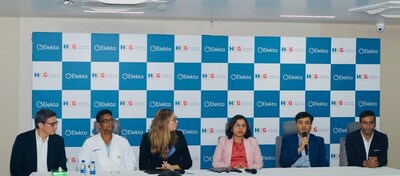

HealthCare Global Enterprises (HCG), Bengaluru, has begun treating cancer patients using Karnataka’s first Elekta Unity MR-Linac. With this milestone, HCG opens up access to MR-guided adaptive radiation therapy for patients across Karnataka and neighbouring regions, bringing one of the most advanced approaches in radiation oncology closer to those who need it.
Elekta is headquartered in Stockholm, Sweden, with over 4,000 employees and offices in more than 40 countries. The company is listed on Nasdaq Stockholm. Each year more than 2 million patients are treated using Sweden’s Elekta solutions across 130 countries.
Unity combines a high-field 1.5 Tesla MRI scanner with a linear accelerator, enabling clinicians to visualise the tumor and surrounding anatomy in real time during treatment. This allows the care team to adapt the treatment plan online to anatomical changes that occur from one treatment session to the next, helping deliver highly precise radiation while protecting surrounding healthy tissue.
Cancer is among India’s fastest-growing health challenges, and Karnataka too is seeing a steady rise in new cases every year. The Global Cancer Observatory (GLOBOCAN) estimates that new cancer cases in India will reach 2.08 million by 2040, a rise of 57.5 percent over 2020 levels. Numbers of this scale call for treatment that is more precise, more personalised, and able to adapt to each patient as their treatment progresses.
One of the first successful cases was of a 74-year-old man with high-risk, localized prostate cancer who was treated with hypofractionated radiotherapy on the Elekta Unity MR-Linac, completing the five-week course without interruption and tolerating treatment well. The real-time visualization and ability to account for prostate movement enabled precise targeting while helping minimise radiation exposure to surrounding organs.
MR-guided adaptive radiotherapy represents an important advancement in precision cancer care, giving clinicians the ability to see the tumour and surrounding anatomy clearly and adapt treatment based on the patient’s anatomy at each session. This allows us to deliver radiation with greater accuracy while minimising exposure to healthy tissues and critical organs. Ultimately, it enables us to offer more personalised treatment approaches, with the potential for better outcomes and improved patient experience.
Dr. Surendra Reddy T, Consultant Radiation Oncologist, HCG Hospitals Hebbal.
For patients, the difference is practical. MR-guided adaptive radiation therapy offers a more personalised treatment experience. Treatment is adapted to their anatomy on the day of each session, providing greater confidence that radiation is delivered precisely to the target while minimising exposure to surrounding healthy tissue.
This approach is particularly valuable for tumors located close to critical organs or in areas where anatomy changes during treatment, allowing clinicians to make informed treatment decisions based on real-time imaging.
The clinical launch at HCG adds to the steady adoption of image-guided, adaptive radiation therapy in the country. As more providers invest in these technologies, MR-guided treatment is set to play a larger part in improving treatment accuracy, supporting better patient outcomes and bringing world-class cancer care within reach of more patients.